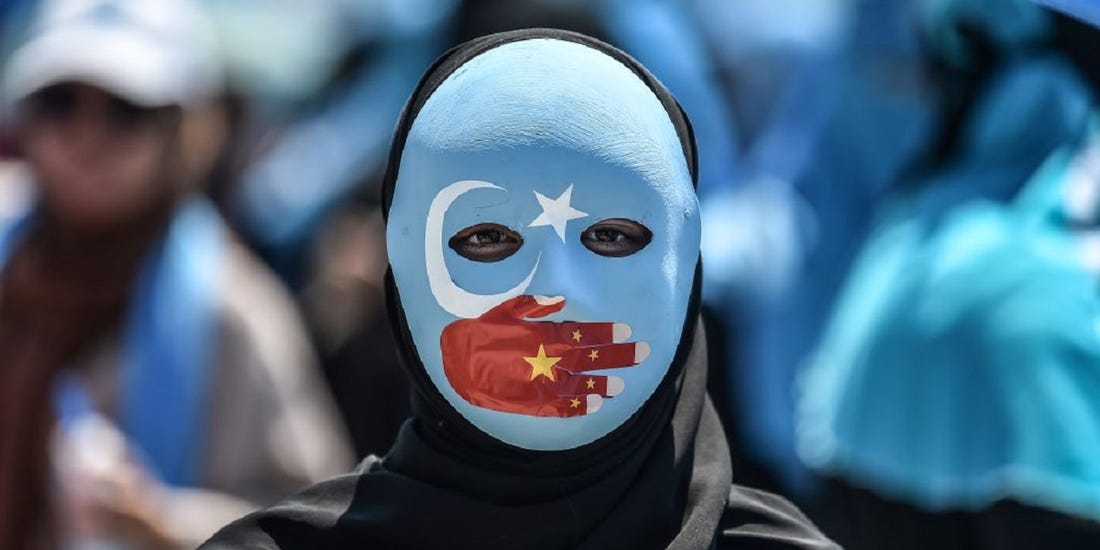

As an active social media user, it has become routine to find videos on my social media feed about the ethnic cleansing of Uighur Muslims. These videos usually showcase the torture and brutalities by the Chinese government on the Uighur Muslims. Millions of people worldwide have viewed these videos, however, the international community has yet to respond against the atrocities committed by the Chinese government. Amidst the world politics and struggles of daily life, these videos fade into the background. As these videos have started to resurface, therefore, I feel it’s high time we educate ourselves about the issue.
Who are the Uighur Muslims?
The Uighur Muslims identify themselves as a Turkic-speaking ethnic minority present in the north-western province of Xinjiang.
The History Behind the Crisis
Cultural Revolution (1949-1976)
Since the 18th century, the Chinese government and Uighur Muslims have fought each other to gain dominance over East Turkestan. In 1949, China was able to get a hold of East Turkestan and change its name to what is now known as Xinjiang. Due to its Muslim majority, Xinjiang was given autonomous status. In reality, despite its status, Xinjiang is still influenced by the Chinese government. The cultural revolution, led by the Mao Zedong, which lasted for a decade, leading to many Uighurs and other ethnic minorities to be subjected to violence as their religious ideologies’ fell into the four olds (old ideology, old culture, old custom and old tradition), which the Cultural Revolution was set on destroying.

The flag of East Turkistan 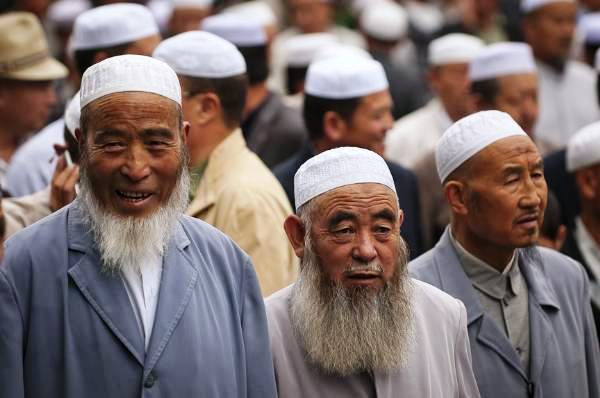
Uighur Muslims
A Breath of Relief (1976-1989)
Deng Xiaoping became the leader, after the death of Mao Zedong in 1976. During his rule, Uighurs were able to enjoy religious freedom through Deng’s “Open and Reform” act. However, things started to take a sinister turn under the rule of Deng Xiaoping’s successor, Hu Yaobang. The friction between the Uighur Muslims and the Chinese government started to intensify at the beginning of the 1990s.
The Tension Escalates (the 1990s to 2000s)
In the 1990s, Hans Chinese (an ethnic majority in China) had started to occupy Xinjiang and establish successful businesses there. Consequently, this led to a wealth gap between the Hans Chinese and the Uighur Muslims. The migration of Hans Chinese to Xinjiang was not appreciated by the Uighur Muslims, who felt that their homeland was being exploited and taken away from them. In addition, the Chinese government had also started to place restrictions on religious freedom. This chain of events led to many Uighurs protesting and clashing with the police. As a result, many Uighurs were denied access to lawyers and arrested without trial. Due to a lack of international support, consequently, many Uighurs resorted to violence, which led to several incidents of bombing in retaliation to the occupation of Xinjiang by Hans Chinese; however, such incidents only took place largely in late 1997 and 2009.

Riots between the Uighur muslims and the Chinese police 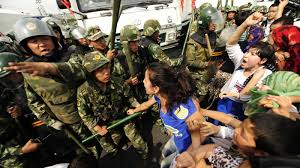
Urumqi riots (2009)
A Façade (the 2000s to Now)
Despite the lack of violent retaliation from the Uighur community, Uighurs are labeled as terrorists, nevertheless. Under the banner of the fight against terrorism, the Chinese government has taken extreme measures that include arresting people for the smallest offenses’ such as reading the Quran. For this reason, many Uighur Muslims are under the threat of losing their identity under the communist regime especially with the introduction of re-education camps: a modern-day version of a concentration camp.
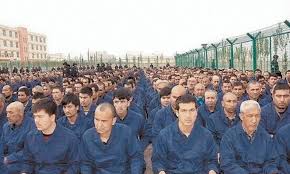
Uighur Muslims in modern day concentration camps 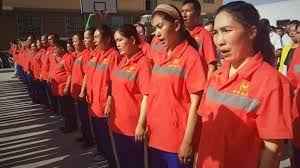
Uighur Muslims in “re-education” camps
Is religious prosecution only towards Uighur Muslims?
Restrictions regarding religious freedom is an issue many religious minorities face. For example: Since 1951, Buddhists have been subjected to cultural genocide. Furthermore, Catholic Christians are not free to practice their religion and are constantly under state surveillance.
The response of the Islamic community regarding the crisis
The silence towards the treatment of Uighur Muslims leads many to question the international community, especially its Islamic subset. The reality behind the silence of countries such as Pakistan stems from China’s “Belt and Road” initiative. Xinjiang is the center of the “Belt and Road” initiative; therefore, for this initiative to be successful, Muslim countries that are a part of the “Belt and Road” initiative must cooperate with China, in spite of, the oppression of Uighur Muslims done by the Chinese government. For instance, According to The Independent, Muslim nations have gone as far as to directly appreciate these “re-education” camps, saying China is taking a great step in fighting “terrorism”.
Conclusion
The world can no longer remain silent about Uighur Muslims and the ordeal they are going through. Moreover, the hypocrisy of the Chinese and Pakistani government should not blind us from the plight of the Uighur Muslims. We should take action, such as voicing out our opinions regarding the ill-treatment of Uighur Muslims in China. In conclusion, we should educate ourselves about the issue and stand up against the oppressing regime of China.


One thought on “Uighur: A tale tainted with hypocrisy and ignorance”
Very insightful read. Really well written, props to the author!