

Standard uniforms, strict rules, totalitarian authority and plain architecture- a description fit for prisons that uncannily equally translates over for schools. Although often contrasted, the comparisons between schools and prisons are often disregarded. Typically disregarded as an overstatement, I, however, understand that there is a maligning truth here to be inspected.
My inquiry first began with an observation of Siddeeq Public School, as I traveled on the Islamabad Expressway. What seemed like an Ottoman fort in the desert, as often seen in the oriental depictions of the cartoon Looney Tunes, to my surprise, was a school. My next instinct was to try to identify it as a prison, seeing its characteristics that resembled what few depictions of jails I had seen. I began my research.

Schools are like prisons – literally!
I first explored the architectural and social similarities between schools and prisons. Schools , like prisons, are administered with great surveillance- which is, at times, highly unjustified in the case of the former. Furthermore, schools, in similitude to prisons, follow a strict code of social conduct, the negligence of which is punishment. Consequently, a certain power dynamic is observed in school which is quite similar to that of a prison. Thus, here one must take note of the famous psychological experiment known as the Stanford prison experiment by Dr. Zimbardo. If a similar study was to be conducted in a school setting, it would have provided us with some interesting parallels.
Moreover, the spatial arrangements of a school and prison reveal some interesting facets of the argument as well. For instance, if one begins to inspect the blue prints of both structures, similarities are uncanny. From long corridors to monotonous rectangular class-rooms (jail cell), the designs of schools mirror those of prisons.

courtesy jansgephardt.com
Additionally, an interesting article at archdaily.com examines this very argument but at a greater scope. Architect and academic Frank Locke, in an interview with the Colombian newspaper El Tiempo, weighed in on the matter with the following lines:
Universities, schools and prisons?
Modern Pakistani universities share a similar fate as well. Architectural and spatial plans see total space utilization as priority. Consequently, classes are modeled economically to use as much space as possible whilst aesthetics are largely ignored. This ignorance is also seen in the external demeanor of universities which presents them more as a correctional facility then a place of learning.
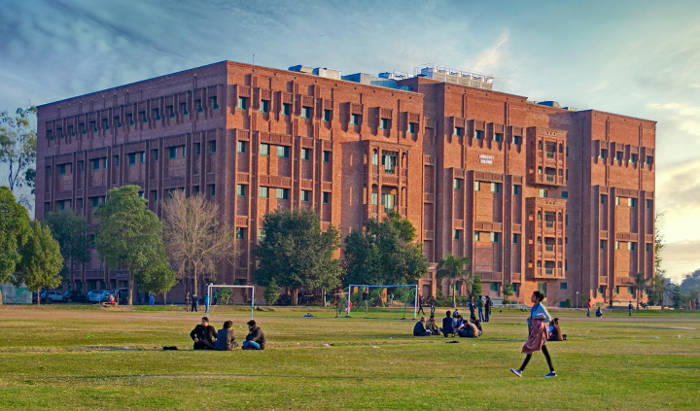
FCCU, Lahore 
Metropolitan Detention Center, USA
Conclusively, one can go on pointing similarities but the burning questions remains: where do we go from here?


