

A Pakistani writer, scholar, communications specialist, filmmaker, former senator, and minister. One of the most familiar faces at IBA for more than 3 decades. He has been invited as a guest lecturer on the invitation of professors and by student associations on countless occasions. In 2008 during the tenure of Dr. Ishrat Hussain (former Dean and Director IBA), Mr. Jabbar was invited to serve as Adjunct Professor. He still currently periodically contributes to this position at the Institute of Business Administration Karachi.
Javed Jabbar and his Style of Teaching
Mr. Jabbar’s role as Adjunct Professor only allows him to take a few sessions each semester. Still, his students have always admired him for the way he describes things with clarity, style, and attention to detail. Mr. Jabbar has always emphasized on discussion-based classrooms. He believes the task of a teacher is to define parameters of topics and then jointly explore them with students. Furthermore, he believes that teachers should allow students to question aspects of the content of textbooks and encourage students to think for themselves and respect their capacity to do so. In my recent discussion with him, he recommended that the duration of some classes at IBA should be longer than 75 minutes to facilitate sustained, purposeful deliberation and dialogue. He argued that a rigid time cut-off for all classes disrupts the momentum of discussion and restricts exploration and thinking to only 75 minutes.

My First Encounter
My first encounter with Javed Jabbar was during my first semester in my course Pakistan History. He was invited as a guest lecturer to give us a session on the role of media and civil liberties. Throughout the semester, I and my friends never came on time. But on that day, on entering we were greeted by 6ft+ man standing in front of us asking, “Where were you rascals?” He stressed the need for punctuality and said it was always the busiest people who always had the time and were punctual.
After the session, he opened for the Q/A session. I asked him, as a former senator and minister, what would you say is your most important contribution to this country? Initially startled by my question, he eventually answered that he believed his most important contributions would be the two laws that he worked on as a senator. These are the introduction of private TV and radio channels through PEMRA and the Freedom of Information Law.
Opinion on Mass Media
As a writer and producer of the film Ramchand Pakistan (2008), Mr. Jabbar was displeased with the poor quality of most of the drama content on TV in Pakistan. He says the reason behind this decline is because networks are completely dependent on ratings which directly translates into Ad dollars for revenue. Mr. Jabbar expressed his regret that because he resigned from the Musharraf cabinet in 2000 he could only get the laws approved but left before the financial models were approved. He would have insisted on a model that did not make channels 100 percent dependent on advertising alone. Viewers should pay far more for the abundant choices of content they presently have.
Activities outside Campus
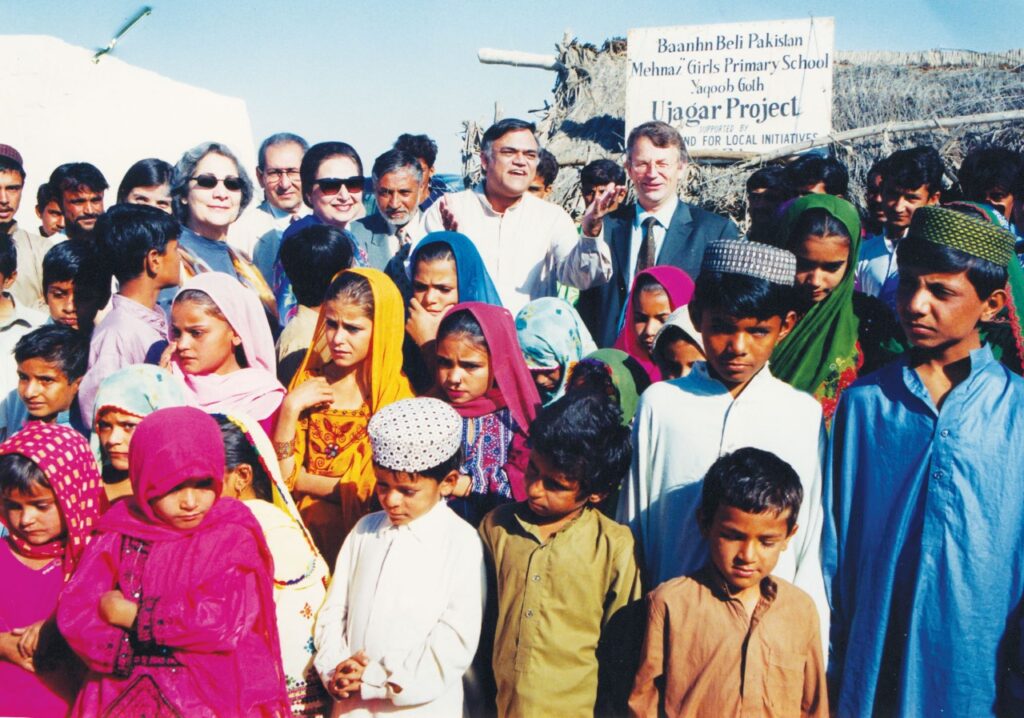
Javed Jabbar also serves as co-founder and chairman of SOS Children Villages (Sindh). This is among many social welfare and development organizations he serves on a voluntary basis. Mr. Jabbar is a renowned author who has written or compiled up to 16 books. In my recent conversation with him, he also informed me he is working on a set of new books describing his political journeys and experiences as senator and minister in 3 Cabinets. He is also working on a new film which is planned for production next year. As the writer-director-producer of Pakistan’s first English language cinema film ” Beyond the last mountain ” screened in 1976. He plans to soon digitalize the only surviving print of that film to enable its re-screening.
At this point in his life, he tries to be a good husband, a good father, and a good listener and thinker.


